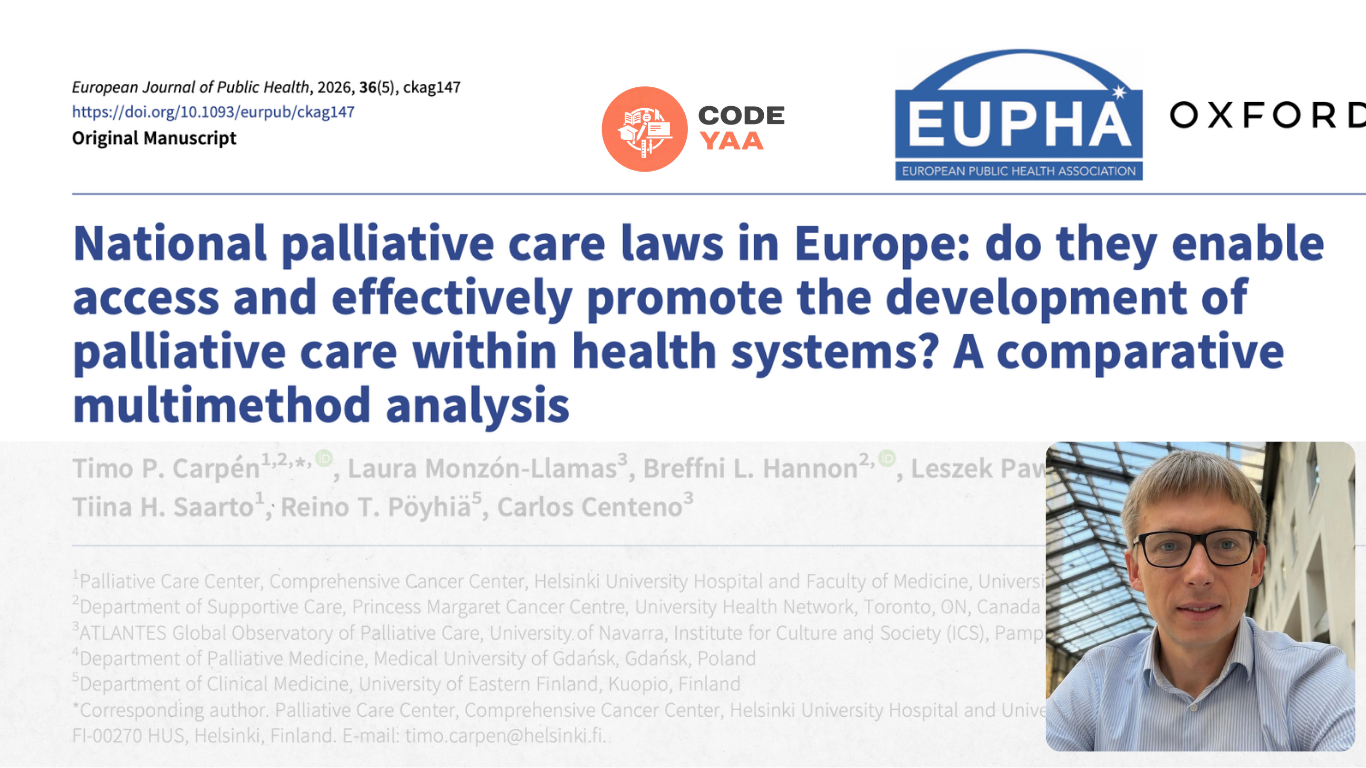
Newly published paper: “National palliative care laws in Europe: do they enable access and effectively promote the development of palliative care within health systems? A comparative multimethod analysis”
FIND OUT MORE AT: https://academic.oup.com/eurpub/article/36/5/ckag147/8772167
Without good legislation, making worthwhile improvement in healthcare, generally, and in palliative care, specifically, is a Sisyphus-like task. Interestingly, a newly published paper by co-authored by researcher involved in the CODE-YAA@PC-EDU project, addresses this question and highlights different legislative approaches that may inform future developments in palliative care. The question is as straightforward as it is important: “How does legislation actually affect the reality of palliative care in European countries?”.
The paper analyses 14 countries’ legislative status quo through a comparative multimethod
study, dissecting to its core what can stop legislation from being the enabling instrument it is supposed to be. The paper goes much more in depth than just mapping the current situation. It analyses the scope and ambition of national legal frameworks, and explores how they may support the development of palliative care within health systems, complemented by insights from interview with key informants.
The core message of this paper is groundbreaking in its simplicity. Framing PC as a fundamental right is indispensable to foster the legitimacy of PC and strengthening access pathways, but at the same time, it is not enough; rights-based recognition alone, lacking actual implementation mechanism, can only go so far in transforming the country’s PC landscape.
It’s like a diving board: even if it helps you make the jump higher, you still need a deep enough pool to land into. And what happens if there is no pool? Access to medicines and research have been found to take most of the hit. And how do you build the pool? How can the road between legislation and effective access to PC made to be as smooth as possible? Through community empowerment, governance and accountability and education, as an example. Strengthening PC education, the core mission of our cost action, proves once again to be the catalysis for meaningful change, for bridging gaps and for building bridges.
From one of the authors, Leszek Pawłowski: “This study provides a unique overview of how national palliative care legislation may support access to palliative care across Europe. I hope that our findings will not only inspire further research but also stimulate discussion on legislative changes that can help ensure timely access to high-quality palliative care for all patients who need it.”
Chiara Biasotti